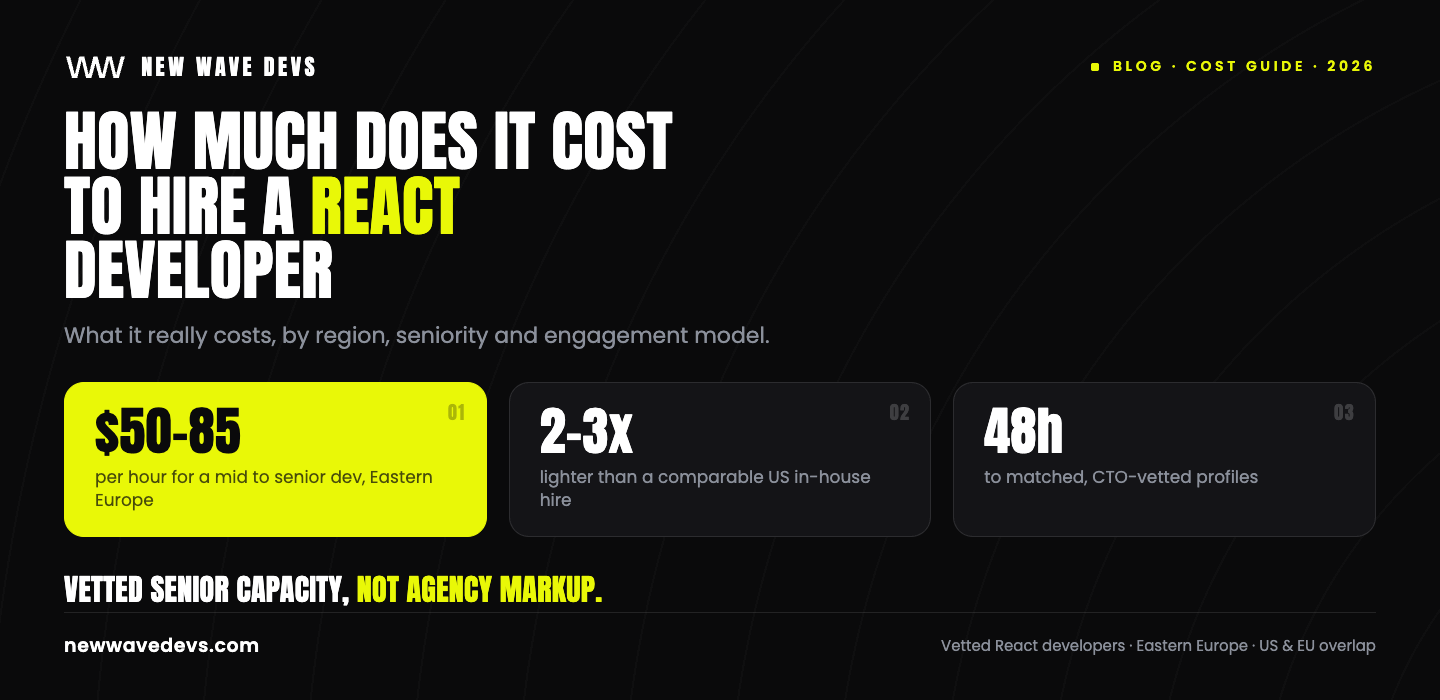
How Much Does It Cost to Hire a React Developer in 2026?
Wondering what a React developer really costs in 2026? Here's the breakdown by region, seniority, and hiring model — plus the hidden costs.

Roman Oliinychenko
7 min read
Jun 30
What actually drives the cost of a React developer
Three levers move the price more than anything else.
- Seniority. A mid-level React developer and a lead who owns your frontend architecture are not the same hire, and shouldn't cost the same. Mid handles features inside an existing codebase. Senior owns complex work end to end. Lead sets the standards and guides the team. The gap between them can easily be 2x.
- Location. This is the biggest single factor. The same skill costs wildly different amounts depending on where the engineer sits — a US-based senior React dev and an equally strong one in Eastern Europe can differ by 2–3x for comparable quality.
- Engagement model. Hiring full-time in-house carries overhead you don't see on the rate card — recruiting, benefits, taxes, equipment, management. A freelancer is cheaper per hour but riskier. Staff augmentation sits in between: a vetted dedicated developer without the in-house overhead.
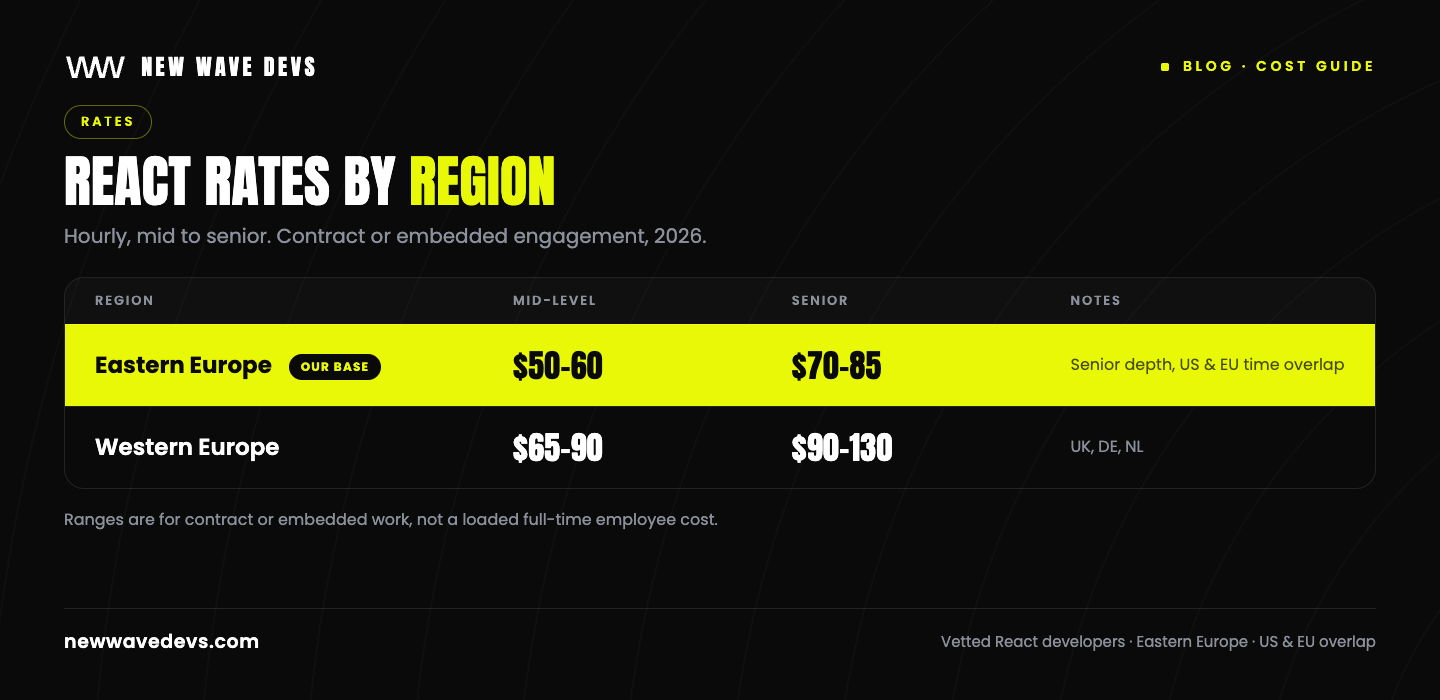
React developer rates by region (2026)
Rough hourly ranges for mid-to-senior React developers. Treat these as ballparks — your mileage varies by exact skill and demand.
- US / Canada — $100–170+
- Western Europe — $65–130
- Eastern Europe (Ukraine, Poland, Romania) — $50–85
- Latin America — $45–75
- South / Southeast Asia — $25–50
Eastern Europe is where a lot of teams land, and for a reason: strong engineering culture, good English, real product experience, and timezone overlap with both the US and EU — at about half the cost of a comparable US hire.
Freelancer vs agency vs staff augmentation
The rate is only half the story. Here's how the models compare on what actually matters.
- Freelance marketplaces look cheapest on paper. But you're vetting strangers yourself, quality is a coin flip, and platform fees and churn add up. Fine for a small one-off; risky for anything you depend on.
- Full-service agencies take the whole project off your plate, but you pay a premium for it, you lose day-to-day control, and you often get a rotating cast of developers rather than someone who learns your codebase.
- Staff augmentation is the middle path: a vetted, dedicated React developer who joins your team and follows your workflow, without the recruiting and overhead of a full-time hire. You keep control of the work; the partner handles sourcing, vetting, HR, and payroll. For most startups scaling a product, this is the sweet spot.
If that's the model you're weighing, this is exactly what we do — you can hire dedicated React developers who plug into your team in about 48 hours.

The hidden costs people forget
The hourly rate isn't the full price. Budget for these too:
- Recruiting and ramp-up. Finding and onboarding an in-house dev can take 1–3 months of salary-equivalent before they're productive. Staff augmentation cuts most of this.
- Bad-hire risk. A wrong full-time hire is expensive to unwind. Look for a free replacement guarantee — it caps your downside.
- Management overhead. Even great developers need direction. Factor in your own time.
- Turnover. Cheap-but-unreliable talent that leaves mid-project costs more than a slightly pricier dev who stays.
How to get the most value (not just the lowest price)
Cheapest and best-value are different goals. A few rules of thumb:
- Match seniority to the work. Don't pay lead rates for feature work, and don't hand architecture to a junior.
- Vet for real product experience, not just a clean CV. Ask for work samples and a live coding round.
- Prefer overlap. A few hours of shared working time saves days of async back-and-forth.
- Insist on transparency — clear monthly or hourly pricing, no surprise fees.
- Start small, then scale. One dedicated developer first; grow to a team once the fit is proven.
The bottom line
For most teams in 2026, a vetted mid-to-senior React developer through staff augmentation lands in a range that's a fraction of a US in-house hire, without the freelance gamble. The exact figure depends on seniority and region — but the bigger win is value: a developer who's already vetted, ready to start fast, and backed by a replacement guarantee.
If you want to skip the sourcing and vetting entirely, hire dedicated React developers and get 2–3 matched profiles within 48 hours.
Next steps
Ready to kickstart your project?
Contact UsDid you
like this
article?
Share
Don't like
filling
out forms?
Schedule a call
Popular Articles


